European spacecraft finds chaotic scene after asteroid deflection experiment
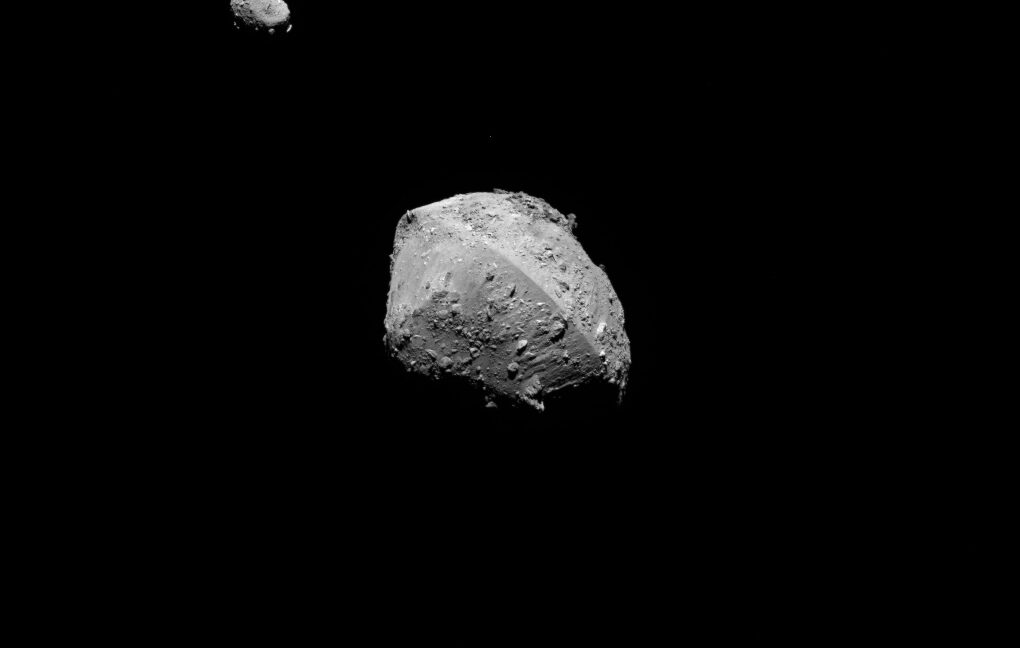
"DART made a really, really large mess. However, we didn’t really know what kind of mess."
Four years ago, NASA dispatched a small spacecraft on a suicide mission to show how humanity might deflect an asteroid on a collision course with Earth. The first-of-its-kind experiment worked beautifully as the solar-powered space probe slammed into asteroid Dimorphos, permanently altering its trajectory.
Using telescopes, astronomers measured changes in the orbit of Dimorphos around a larger asteroid companion named Didymos in the aftermath of NASA's Double Asteroid Redirection Test (DART) mission. The spacecraft released some 10 billion joules of energy as it impacted Dimorphos in September 2022 at more than 13,700 mph (6.14 kilometers per second), shortening the asteroid's 12-hour orbit around Didymos by about 33 minutes, 25 times the most conservative expectation.
But scientists could only learn so much from DART. The collision destroyed the spacecraft, as expected. DART recorded images as it took aim on Dimorphos, but only faraway telescopes and a small CubeSat that briefly detected the impact flash could see what happened next.
"We knew right away that the impact was successful, that DART made a really, really large mess," said Sabina Raducan, a planetary scientist at the International Space Science Institute in Bern, Switzerland. "However, we didn’t really know what kind of mess. We were still missing pieces of the puzzle."
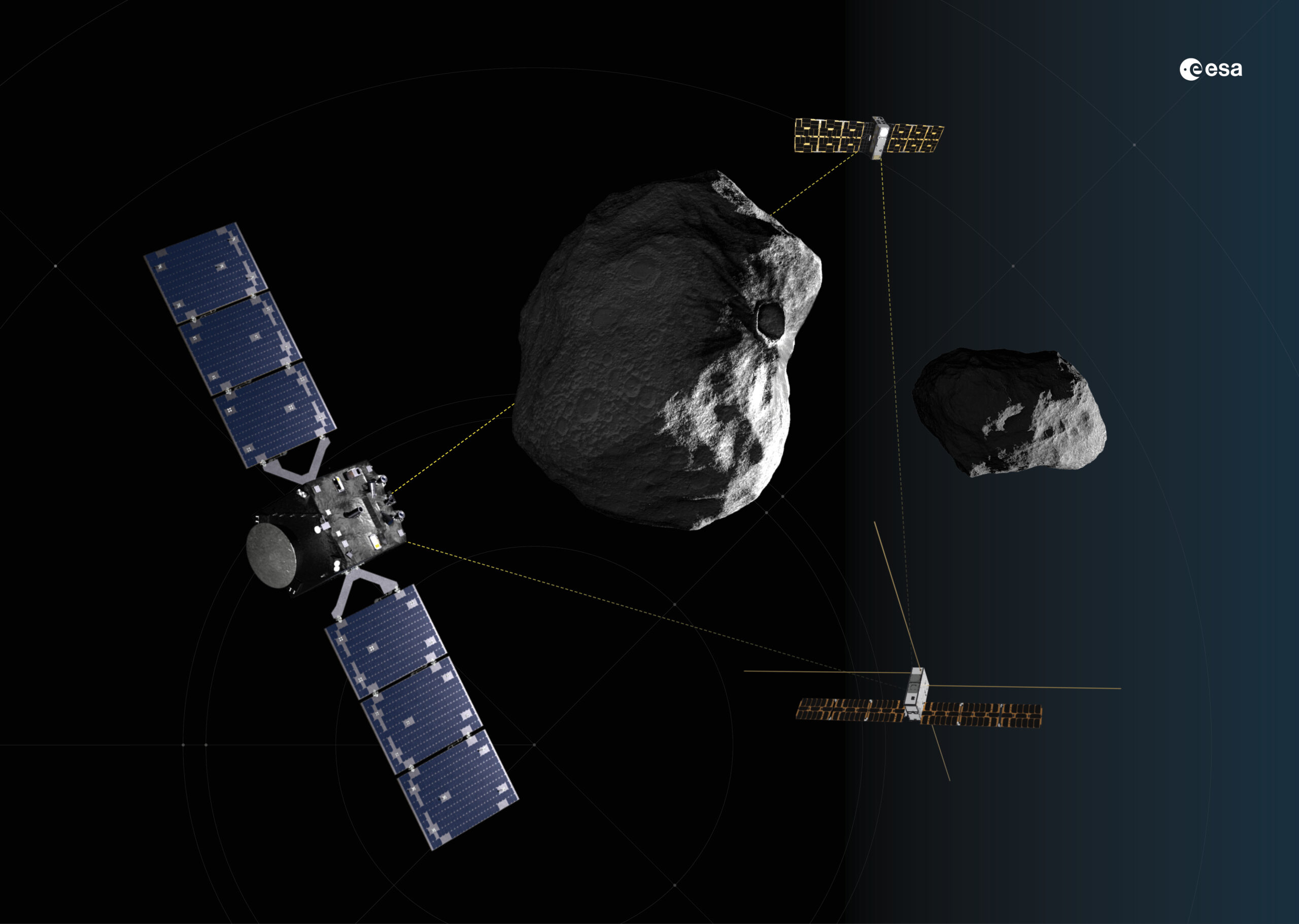 Artist's illustration of the Hera spacecraft with its two deployable CubeSats, Juventas and Milani, in the vicinity of the Didymos binary asteroid system.
Credit:
ESA-Science Office
Following up
The European Space Agency's Hera spacecraft recently arrived in the vicinity of Didymos and Dimorphos after a two-year journey from a launch pad in Florida. On Wednesday, ESA released Hera's first views of the scar left by DART on Dimorphos. The images show the car-sized impactor carved out a crater the size of a stadium, nearly as big as Dimorphos itself, a rugged chunk of extraterrestrial rock measuring about 500 feet (151 meters) across.
Mission planners selected Didymos and Dimorphos for the deflection experiment because they are similar to many near-Earth asteroids, but there's no risk of them striking our home planet. Scientists weren't sure what Hera would find when it got to the double asteroid, currently orbiting the Sun about 120 million miles (193.5 million kilometers) from Earth.
"I would say we had two kinds of predictions: either we made a crater, or we reshaped the asteroid," said Patrick Michel, Hera's principal investigator from Côte d’Azur Observatory in Nice, France. "In fact, we did both because the crater is so large that the shape has changed. Therefore, we are in a sort of a transition between just cratering and global transformation, and we are still not sure how this can happen."
Hera found Didymos, the larger of the two asteroids, spinning on its axis just as DART observed on final approach in 2022. Dimorphos is no longer so stable.
"As Hera returned more images, it became clear that the DART impact has left Dimorphos tumbling wildly in its orbit,” says Michael Kueppers, ESA’s Hera mission scientist.
The Hera spacecraft will fly closer to Didymos and Dimorphos over the next six months to obtain more detailed observations. Hera will release two small sub-satellites to attempt landings on Dimorphos and collect data on the asteroid's composition, internal structure, and mass.
Scientists will use this information to reconstruct the dynamics of DART's impact four years ago and better understand how a future deflection mission might move an asteroid off a trajectory that actually threatens Earth. Near-Earth asteroids come in many shapes and sizes, with different densities and makeups, so knowledge of Dimorphos's physical properties will anchor predictive computer models teaching scientists how best to deflect all types of asteroids.
"Once we understand, we have a breakthrough, which really solves planetary defense," Michel said in an interview with Ars.
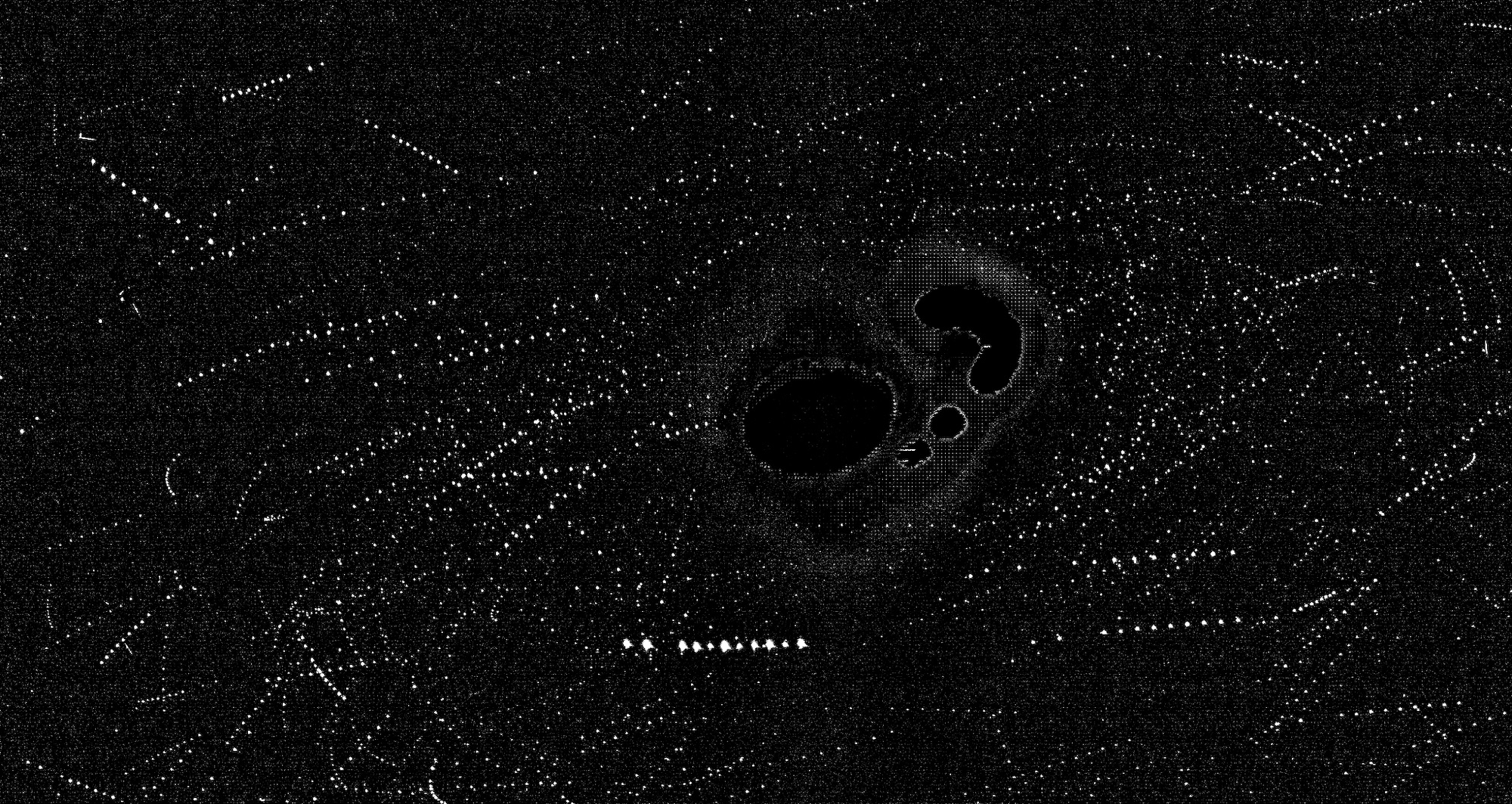 This is a composite image combining 11 long-exposure images from Hera's Hyperscout-H instrument, centered on the Didymos asteroid. The dot trails correspond to hundreds of boulders of differing sizes in motion around the Didymos-Dimorphos system. The two asteroids have been subtracted from the image for improved visualization of the boulders. These images were acquired on November 6 with an approximate distance of 29.9 kilometers (18.6 miles) from the asteroids.
What a mess
In its initial reconnaissance this month, Hera spotted hundreds of boulders surrounding the double asteroid. This was not entirely unexpected. A picture taken by the Hubble Space Telescope shortly after DART's impact showed a cloud of material streaming behind Didymos and Dimorphos, but scientists were astonished by the extent of the debris swarm in Hera's first images.
"As we approached Didymos and Dimorphos, we quickly realized the asteroids were not alone," said Naomi Murdoch, planetary scientist at the Institut Supérieur de l'Aéronautique et de l'Espace in Toulouse, France. "In fact, they had a lot of company."
原文出处:Ars Technica (本文由聚合程序自动采集,版权归原作者所有)